Quick answer: Condition is not a simple scale from perfect to poor. Collectors ask whether an object is original, complete, stable, attractive, honestly repaired, and still desirable in its category. Learn how to document those answers before estimating a value range. Use the steps below to collect evidence before you search for an exact maker, date, or value.
Condition means more than “looks old”
An antique can have honest age-related wear and still be desirable. It can also look polished and complete while hiding a repair, replacement, or modern finish that changes the market. Condition research starts by separating original material from later intervention and describing what is visible without exaggeration.
Ask five practical questions: Is the object complete? Is it structurally stable? Are its surfaces original? Are repairs visible or hidden? Does the wear fit the object’s age and use? The answers matter differently in each category. A repaired porcelain rim, refinished table, replaced jewelry stone, and serviced clock may each be judged by different collector expectations.
Condition should be documented before cleaning. Photograph the object as found, keep close-ups of damage and repairs, and record any action taken afterward. A before-and-after record protects the research history and makes a later appraisal more useful.
Original finish versus restoration
Original surfaces can preserve evidence of how an object was made and used. Furniture collectors may care about original finish, veneer, hardware, and color; ceramics collectors may care about intact glaze and decoration; jewelry buyers may care about untouched settings and matching stones. A sympathetic restoration can stabilize an object and improve presentation, but it should not be confused with untouched condition.
Look for broad or uneven color changes, fresh sharp edges, finish pooling in recesses, sanding marks, overpainting, new screws, bright replacement hardware, cleaned gilding, or a surface that is too uniform for the claimed age. These clues need context. An old item can be polished, stored carefully, or repaired in a way that is difficult to see, while a modern reproduction can be distressed convincingly.
Do not strip, polish, oil, or repaint a possible antique just to make the condition easier to judge. Conservation and restoration should be reversible where possible and carried out by someone experienced with the material.
Damage, repairs, and replacements
List damage by type, location, size, and stability. Chips, cracks, losses, stains, dents, breaks, warping, loose joints, moth damage, rust, missing keys, and replaced components each communicate something different. A small visible repair may be less concerning than an unstable structural problem hidden under a finish.
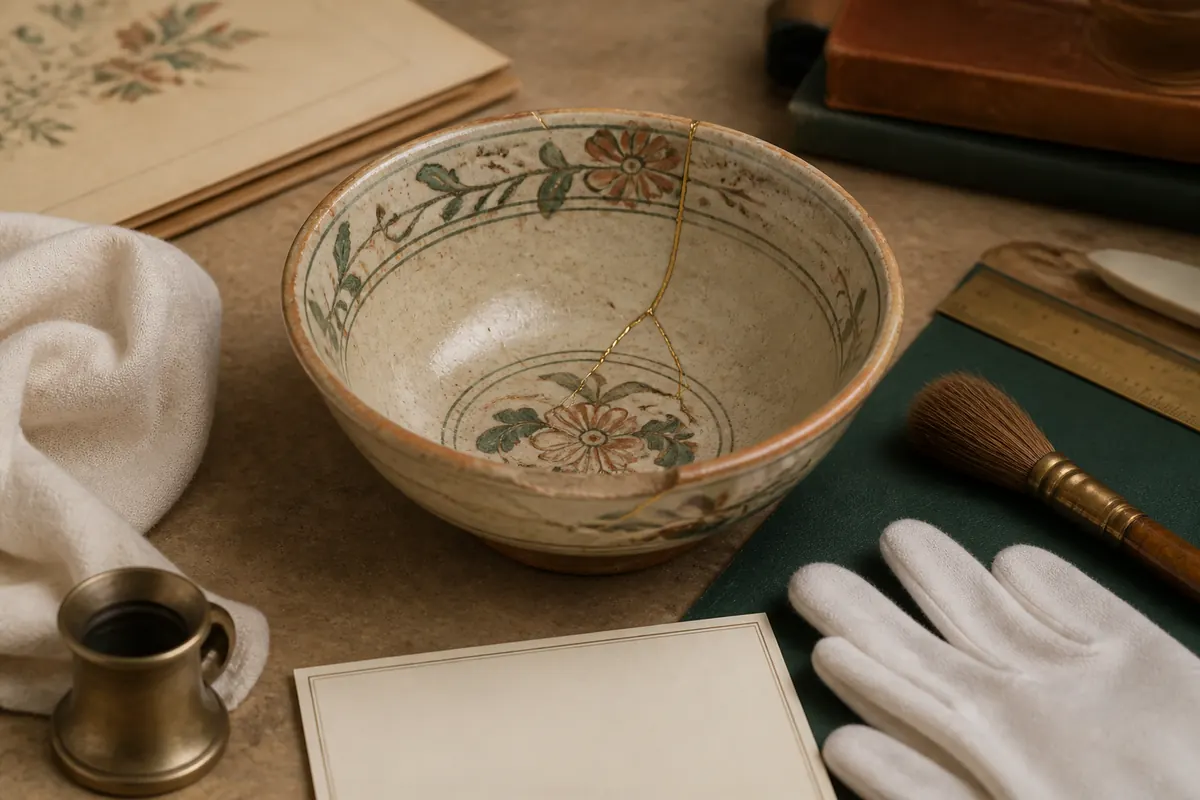
Repairs are not automatically bad. A historic repair can be part of an object’s story, and professional conservation can keep a fragile item usable. The valuation question is whether the repair is stable, visible, sympathetic, documented, and acceptable to the market for that category. A replacement part may preserve function while reducing originality.
Photograph the defect with a scale and a wider image showing its position. Write “possible filled chip” or “old repair visible under light” when you are not certain. Honest uncertainty is more useful than an exact diagnosis made from a phone photo.
- Use a close-up for the damage and a wider image for location.
- Describe whether the problem is stable, loose, sharp, active, or repaired.
- Check whether matching parts, labels, boxes, keys, lids, or mounts are present.
- Keep original parts and restoration records with the object whenever possible.
Completeness and provenance can change the range
Completeness matters when an object was designed as a set or depends on small parts. A clock without its pendulum, a tea service missing a creamer, a brooch without its original box, or a furniture suite split across buyers may compare differently from a complete example. Record what is present, what is missing, and whether the missing part is essential to identification or use.
Provenance can support value when it is specific and documented. Old receipts, auction catalogs, family photographs, exhibition labels, dealer invoices, letters, and prior appraisals can explain an object’s history. A broad story such as “it belonged to my grandmother” is meaningful personal context but does not by itself prove age, maker, or market premium.
When you compare completed sales, match condition and completeness as closely as possible. Do not use the highest result for a museum-quality example to price a repaired, incomplete, or later version.
Estimate value without false precision
An indicative value range is more honest than a single exact number when the evidence is incomplete. Start with identification, then compare category, maker, form, size, materials, condition, completeness, provenance, venue, and sale date. A dealer price, insurance replacement value, auction result, and private sale price answer different questions.
Antique Identifier can provide a research-oriented starting point from photographs and call attention to the details that may affect value. Use that result to decide what to verify, not as a formal appraisal. An unusual, signed, precious-metal, or high-value item deserves specialist review before you buy, sell, insure, donate, or divide an estate.
For resale planning, add the costs around the object: transport, cleaning by a qualified professional, restoration, photography, marketplace fees, shipping, packaging, storage, and returns. Use the free profit and pricing tools on this site to see what remains after those costs rather than confusing a headline price with net proceeds.
Condition report template
Use these headings when you save a research note or create a listing. A clear condition report improves both trust and future identification.
- Overall: complete, incomplete, stable, unstable, working, or display-only.
- Surfaces: original finish, polished, refinished, overpainted, faded, stained, or worn.
- Damage: cracks, chips, dents, losses, scratches, corrosion, warping, or insect damage.
- Repairs: location, apparent age, visibility, materials, and whether documented.
- Replacements: stones, hardware, glass, feet, handles, keys, pendulums, or labels.
- Provenance: documents, photographs, receipts, family history, and what remains unverified.
Match condition to the market question
Condition does not have one universal effect. A collector may value original finish and untouched surfaces, while a functional object may be judged more heavily on whether it works safely. A dealer may price a damaged piece for restoration potential, while an insurer may need a specialist to separate replacement cost from current market value. State which question your estimate is trying to answer.
Use precise language instead of broad labels such as “excellent” or “good.” Say where the finish is worn, whether a crack is stable, which parts are missing, whether a repair is visible, and whether a replacement appears old or recent. Photograph the damage with a full view and a close-up. A small chip on a common object may be minor; the same loss on a rare matching set can affect completeness and price much more.
Compare only genuinely comparable examples. Match the maker, model, size, material, completeness, restoration, and selling venue before using a result as a benchmark. A high asking price is not proof of value, and a low auction result may reflect poor presentation, timing, or a hidden condition issue. A transparent condition report lets the next researcher update the estimate when better evidence appears.
Save condition photographs at the same time as identification photographs, before cleaning or restoration changes the evidence. If a professional performs conservation, keep invoices and before-and-after images with the object record. Future buyers, appraisers, and family members can then distinguish original wear from later work and understand why two otherwise similar examples command different prices.
When a condition issue is uncertain, describe the symptom and avoid diagnosing the cause. “Hairline visible near the rim” is more useful than “structural crack” if you have not examined the object in person. “Surface looks bright and uneven” is safer than claiming it was polished or refinished without evidence. This precision protects the research record and leaves room for a qualified specialist to update the conclusion.
For an online listing, put the most decision-relevant condition facts near the beginning rather than hiding them at the end. Buyers need to know whether the item is complete, stable, functional, repaired, or sold for parts. Clear disclosure can reduce returns and makes a lower but credible price easier to understand. The same discipline improves a private collection record even when no sale is planned.
Take the next photo with Antique Identifier.
Scan a find on Android or iPhone to get a first-pass identification, age clues, history, and an indicative value range for your research.


Questions collectors ask
Is antique wear always bad for value?
No. Honest age-related wear can be desirable when it supports originality and does not compromise stability or appeal. The effect depends on category, severity, and collector expectations.
Does restoration reduce antique value?
Sometimes, but not always. Stable, well-documented conservation may protect an object, while aggressive refinishing, hidden repairs, or replaced parts can reduce originality and market confidence.
Can a photo determine an antique’s exact value?
A photo can support an indicative range, but exact market value depends on verified identity, condition, provenance, comparable sales, venue, and current demand.
Useful research tools
Research note: Photo-based results and calculators are for discovery and planning. They are not formal appraisals, authenticity certificates, insurance reports, or guarantees of a sale price. Read the valuation disclaimer.