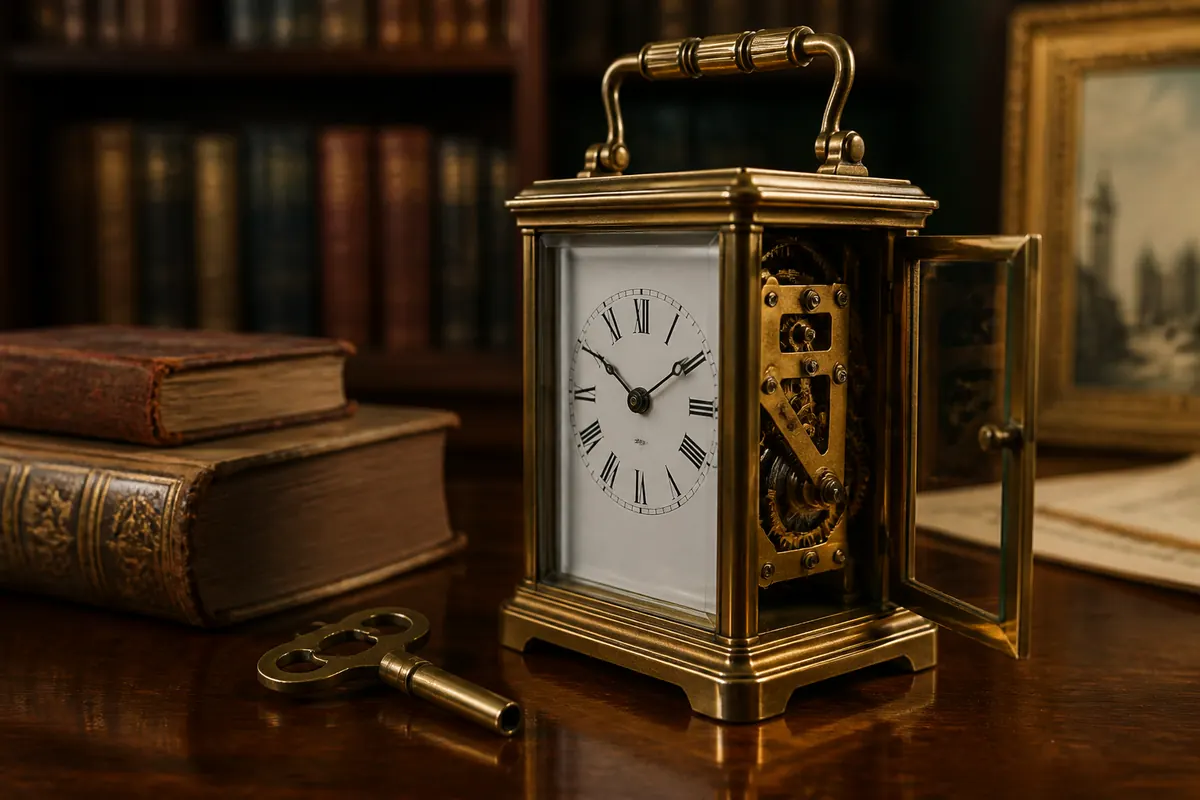
Quick answer: An antique clock has at least three stories to read: the case, the dial, and the movement. They may be original to one another, or they may have been repaired, replaced, or assembled over time. Photograph each layer before you decide what the clock is or what it may be worth. Use the steps below to collect evidence before you search for an exact maker, date, or value.
Identify the clock’s form and purpose
Begin with the clock as an object. Is it a mantel clock, wall regulator, bracket clock, carriage clock, longcase clock, French-style clock, schoolhouse clock, or a smaller travel timepiece? Record dimensions, materials, doors, feet, handles, finials, and whether the clock is intended to be carried, mounted, or placed on furniture.
Photograph the front, back, sides, top, underside, dial, pendulum, weights, winding points, and any removable panels. Do not force a door, winding key, hand, pendulum, or chime mechanism. If the clock is running, note what it does, but do not treat operation as proof of originality or age.
The case can suggest a style and period range, but clocks were often re-cased, refinished, exported, or fitted with replacement movements. A richly decorated case with a newer movement may still be attractive and collectible; the correct description simply needs to acknowledge the combination.
Read the dial and markings
Look at the dial material and design: painted metal, enamel, porcelain, silvered surface, brass, wood, or another substrate. Note numerals, chapter rings, subsidiary dials, calendar apertures, moon phases, retailer names, maker signatures, and decorative motifs. Photograph the dial straight-on without reflections, then take close-ups of any text.
Names on dials can represent makers, retailers, importers, distributors, or later additions. Search the wording exactly, but compare the lettering and placement with documented examples. A retailer’s name can be historically useful without meaning that the retailer made the movement.
Inspect the hands and their relationship to the dial. Mismatched hands, a replaced dial, filled holes, fresh paint, or inconsistent aging may point to restoration. A clock can retain an old movement while wearing a later dial, so date each part rather than forcing one date over the entire object.
Photograph the movement without risking damage
The movement often contains the strongest identification clues, but it is also the part most likely to be harmed by careless handling. Photograph it through an open door or panel if possible. Capture plates, wheels, bells, springs, pendulum suspension, hammer arrangement, maker stamps, serial numbers, and labels. Use a tripod or rest your hands so the image is sharp.
Do not remove a movement, apply oil, adjust screws, or clean brass based on an online suggestion. Clock movements have delicate tolerances and old dirt can be part of the evidence. If a panel must be removed, let a qualified clockmaker do it and record which screws and parts belong where.
Compare the movement’s construction with the proposed case and period. Plates, bridges, escapement, winding arrangement, striking work, and serial numbers can narrow a maker or manufacturing context, but reliable attribution often depends on specialist reference material and hands-on inspection.
- Photograph the movement before any cleaning or adjustment.
- Include a scale reference only when it can be placed safely.
- Record every number, stamp, paper label, and repair note.
- Never wind or run an unknown clock if parts appear loose, bent, or damaged.
Use sound, function, and condition as context
Chimes and striking patterns can support an identification, but sound alone is not a maker’s mark. Note whether the clock runs, gains or loses time, strikes correctly, and has a complete pendulum, key, weights, bell, or winding mechanism. If it is not working, describe the symptom rather than guessing the cause.
Condition is particularly important for clocks because missing or altered components can be expensive to replace. Look for cracked veneer, replaced glass, damaged enamel, over-cleaned brass, refinished wood, missing hands, changed feet, repaired hinges, and non-original keys. Photograph each issue in place and explain whether it affects display, operation, or both.
Provenance can help when it includes an old photograph, receipt, service record, retailer label, family inventory, or estate document. A story without supporting evidence is still worth recording, but label it as unverified so it does not become a false certainty in the next sale.
Build a clock research brief with Antique Identifier
Use a photo identifier to organize the first pass: establish the likely clock type, compare case styles, identify visible materials, and list the marks or movement details that deserve closer inspection. Upload more than the front face when possible. The best result is not simply a name; it is a shortlist of hypotheses and the clues that would confirm or challenge them.
Antique Identifier can help you get from “old clock” to a more useful research question such as “likely brass carriage clock with a retailer-signed dial; inspect the movement and case fittings.” That makes subsequent research and a conversation with a clockmaker more efficient.
For a signed clock, rare movement, important provenance, or insurance valuation, use a qualified clock specialist. A photo result can guide your next step but cannot reliably verify the condition of hidden parts, the originality of a movement, or the cost of restoration.
Antique clock checklist
Save this checklist with the photos so another person can follow the identification.
- Record clock type, dimensions, materials, doors, feet, handles, and decorative features.
- Photograph the dial, signatures, retailer names, labels, serial numbers, and case marks.
- Capture the movement, pendulum, weights, chimes, key, and winding points without forcing parts.
- Document replacements, repairs, refinishing, missing components, and operating symptoms.
- Keep provenance documents separate from assumptions about age or maker.
- Use a clockmaker or specialist for safe opening, servicing, and formal valuation.
Do not date the case in isolation
An antique clock is a working assembly, and its case, dial, movement, hands, pendulum, key, and labels may not have the same history. A later movement can be installed in an older case, a dial can be repainted, and a retailer can sign a clock made by another workshop. Photograph every component that can be seen without forcing a door, removing a panel, or turning a winding arbor.
Listen and observe carefully, but do not treat operation as proof of age. A clock that runs may still have replacement parts, while a clock that does not run may only need safe professional service. Record whether the hands move freely, whether the pendulum or weights are present, whether the chimes are complete, and whether there are signs of oil, corrosion, cracks, or previous intervention.
When you find a maker or retailer name, compare the exact case shape and movement layout with reliable references. A photograph can help you form a shortlist and prepare a conversation with a clockmaker, but hidden movement condition, originality, and restoration cost require hands-on expertise.
Do not remove a movement simply to reveal a serial number. Photograph accessible screws, plates, labels, and case fittings, and note whether the clock has a key, pendulum, bell, or weights. A specialist can often learn more from a careful description of what is present and missing than from a forced opening that bends a door, damages a thread, or loses a small component.
Clock value is often tied to completeness and serviceability as much as decoration. Record the original key, pendulum, weights, bell, case glass, and movement cover, then note whether the clock has been stored safely. A dramatic case with a missing movement is a different research subject from a complete working example. Keeping those categories separate prevents a visually similar sale from creating an unrealistic expectation.
If the movement is accessible without tools, photograph it from several angles and include a scale reference. Avoid touching gears, oiling pivots, or testing the chime repeatedly. The goal is to preserve information for identification, not to prove that the mechanism works. A clockmaker can assess safety and originality after you have created a careful visual record.
Take the next photo with Antique Identifier.
Scan a find on Android or iPhone to get a first-pass identification, age clues, history, and an indicative value range for your research.


Questions collectors ask
What is the most important part of an antique clock to photograph?
Photograph the whole clock, dial, back, case details, and movement if it can be done safely. The case, dial, and movement should be compared rather than dated separately in isolation.
Should I wind an old clock to see if it works?
Do not wind or run an unknown clock when parts look damaged, loose, dry, or bent. A clockmaker can inspect it safely.
Does a signed clock dial prove the maker made the whole clock?
No. A dial signature may identify a maker, retailer, or importer, and clocks can contain replacement cases, dials, or movements.
Useful research tools
Research note: Photo-based results and calculators are for discovery and planning. They are not formal appraisals, authenticity certificates, insurance reports, or guarantees of a sale price. Read the valuation disclaimer.