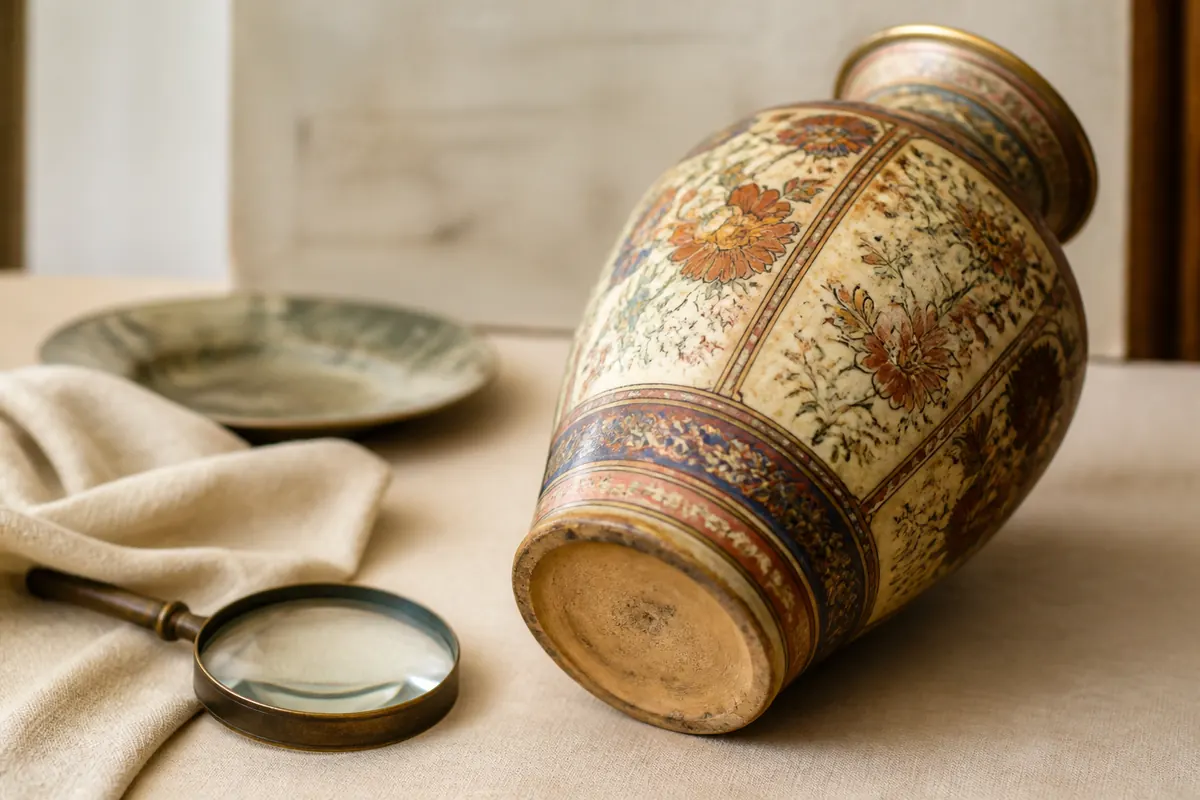
Quick answer: The mark on the base of a ceramic object is an invitation to investigate, not a shortcut to an exact answer. Strong pottery identification compares the backstamp with clay, glaze, shape, decoration, wear, and the history of the piece. Use the steps below to collect evidence before you search for an exact maker, date, or value.
Photograph the pottery before you clean it
Begin with the whole object in neutral light. Photograph its profile, rim, handles, foot, interior, decoration, and base. A base mark can be difficult to interpret when a piece is dusty, stained, or covered with old residue, but aggressive cleaning can damage decoration, remove labels, or alter a surface that helps date the piece.
Use a soft brush or dry cloth only for loose dust unless a ceramics conservator has advised otherwise. Avoid soaking, bleach, abrasive powders, metal polish, and household chemicals. A crack, restored rim, or filled chip should be photographed rather than hidden because condition can be central to both identification and value.
Place a ruler beside the object and record height, diameter, weight if practical, and whether the piece is hollow, thrown, molded, pressed, or assembled. Size and construction can separate a small cabinet example from a later mass-market version with a similar mark.
Classify the mark before you search it
Pottery marks can be printed under glaze, impressed into the clay, painted by hand, incised, transfer-printed, applied as a paper label, or added as a retailer or decorator mark. Describe the mark in plain terms before looking for a match: color, shape, wording, symbols, initials, numbers, country text, and placement. Note whether it is crisp, worn, blurred, broken, or partly hidden by glaze.
Look for more than a company name. A mark may include a pattern number, shape number, artist initials, decorator code, registration symbol, date code, factory location, or retailer name. Some marks changed over time; a small difference in lettering, symbol, or country wording can be more important than a broad visual resemblance.
When you search, use quotation marks around legible wording and add the material or shape. Search terms such as “blue crown mark porcelain vase” are more useful than a vague query for “old vase.” Keep a copy of the original mark photo because search results can encourage you to see letters that are not actually there.
Match the mark to the clay and glaze
An identification becomes stronger when the body and surface agree with the mark. Earthenware, stoneware, porcelain, and other ceramic bodies differ in color, density, translucency, texture, and firing characteristics. You do not need to perform a destructive test; observe the exposed foot rim, unglazed areas, chips, and the weight and sound of the object without tapping it hard.
Glaze can be glossy, satin, matte, crackled, crystalline, flowing, pooled, or uneven. Look at how it sits around the foot, under handles, in carved recesses, and at the edge of the rim. Decoration may be painted over glaze, painted under glaze, transfer-printed, gilded, or applied as a raised element. These details can narrow a production method and help expose a reproduction that has copied only the appearance of an older mark.
Form matters as much as surface. Compare the proportions, foot ring, rim shape, handles, spout, lid, and balance of the object with known examples. A mark associated with one shape should make sense on the object in front of you. If the mark, body, and form disagree, record the conflict instead of forcing a match.
- Photograph the base straight-on and at a slight angle to show impressions.
- Capture a close-up and a wider image showing where the mark sits.
- Note whether the mark is under glaze, over glaze, impressed, or attached.
- Compare clay color and foot construction with verified reference examples.
Use decoration and wear as supporting evidence
Decoration can reveal a factory, an artist, a pattern family, or a later alteration. Look at brushwork, repeated motifs, gilding, transfer edges, and how decoration wraps around the form. Hand-painted decoration can vary naturally, while transfers and modern prints may repeat with machine-like precision, but neither observation is a standalone authentication test.
Wear should make sense for the object’s use. The foot may show shelf abrasion, the rim may show handling, and the base may carry old felt, labels, or scratches. Artificial aging can be added, and a genuine older body can receive newer decoration. Photograph unusual wear, overpainting, glaze loss, and repairs so the story remains visible.
If a piece is part of a set, photograph the group as well as each base. Matching forms, colors, marks, and damage patterns can reveal whether a set is complete, assembled, or mixed across production runs.
From identification to a sensible value range
Once you have a likely maker or pattern, separate identification from valuation. Search for comparable completed sales with the same form, size, mark variant, condition, and completeness. Retail asking prices show ambition; sold results provide stronger market evidence. Account for whether the example is a single piece, a pair, a service, a rare colorway, or a damaged item.
Antique Identifier can help you organize a first-pass hypothesis from photos and point out features worth checking. A result may suggest a category, period, or possible origin, but it should not turn an uncertain mark into a guaranteed attribution. For rare studio pottery, important Asian ceramics, a signed artist piece, or a piece with a disputed restoration, use a specialist before making a major financial decision.
Keep your evidence with the research: original images, mark transcription, measurements, comparable links, condition notes, and any provenance. That record will be more valuable than a single search result when you revisit the piece later.
Pottery marks checklist
Use this sequence to keep a ceramic investigation focused and reversible.
- Photograph the whole form, decoration, rim, interior, foot, and base.
- Transcribe every word, number, symbol, and visible country reference.
- Classify the mark’s application method and compare it with the glaze.
- Check clay body, foot ring, shape, handles, lid, and decoration for agreement.
- Record chips, cracks, restoration, crazing, missing parts, and old labels.
- Compare verified sold examples before estimating a range or listing price.
Build a ceramic comparison set
Once the mark has been transcribed, collect a small comparison set instead of relying on one visually similar listing. Include a confirmed example with the same backstamp, an example with a similar form but a different mark, and a later or reproduction example if one is available. Compare base shape, glaze, decoration, clay color, foot ring, and how the mark sits under or over the glaze.
Photographs can hide scale and surface depth, so record the height, width, opening, weight, and any unusual molding lines. For a covered piece, check whether the lid fits naturally and whether the finial, handle, or knob matches the body. For a set, note whether the pieces share the same mark, wear, color, and proportions rather than assuming they were sold together.
Value research should follow identification, not lead it. Search completed sales using the maker, form, size, decoration, and condition together. Keep asking prices separate from sold results and disclose chips, hairlines, restoration, crazing, missing lids, and later decoration when you describe the piece.
Do not treat a clean surface as evidence of modern manufacture or a dirty surface as evidence of age. Glaze, kiln effects, soot, storage residue, and later cleaning can change how a mark or decoration appears. Photograph the piece before gentle dusting, and consult a ceramics specialist before attempting to remove paint, adhesive, mineral deposits, or old labels.
If a pottery mark is partly missing, describe the visible shapes without guessing the letters. Compare the mark’s spacing, line weight, and placement with reliable references, then look for agreement in the vessel itself. A copied mark on an unrelated form is a useful warning. It does not prove fraud, but it does mean the attribution needs more evidence before you use it in a listing or valuation conversation. Keep the photos and transcription together in the object record.
Take the next photo with Antique Identifier.
Scan a find on Android or iPhone to get a first-pass identification, age clues, history, and an indicative value range for your research.


Questions collectors ask
Does a pottery mark guarantee value?
No. A mark can identify a maker or factory, but value also depends on form, rarity, decoration, size, condition, completeness, provenance, and current demand.
How do I photograph a pottery mark?
Use even light, hold the camera parallel to the base, tap to focus, and take both a close-up and a wider photo showing the mark’s position.
Should I wash an old ceramic before identification?
Avoid soaking, abrasives, bleach, and polishing until the piece has been documented and researched. Cleaning can damage surfaces, labels, and evidence of age or repair.
Useful research tools
Research note: Photo-based results and calculators are for discovery and planning. They are not formal appraisals, authenticity certificates, insurance reports, or guarantees of a sale price. Read the valuation disclaimer.